
Dubai’s tourism industry is one of the most exciting employment ecosystems on earth. Tens of thousands of expat workers from across Asia, Africa, Europe, and beyond fill roles in hotels, restaurants, airlines, tour agencies, desert safari companies, and luxury resorts every single year. For most of them, the UAE is more than just a job — it is a life-changing opportunity to earn a tax-free salary, build savings, and gain international career experience that money simply cannot buy at home.
But working in any country requires understanding the rules, and the UAE’s labor law framework has undergone significant evolution leading into 2026. If you are an expat currently working — or planning to work — in the UAE tourism sector, these changes affect you directly. Here is everything you need to know, explained clearly and practically.
The Foundation: What Law Governs Expat Workers in UAE Tourism
Federal Decree-Law No. 33 of 2021 — Still the Backbone
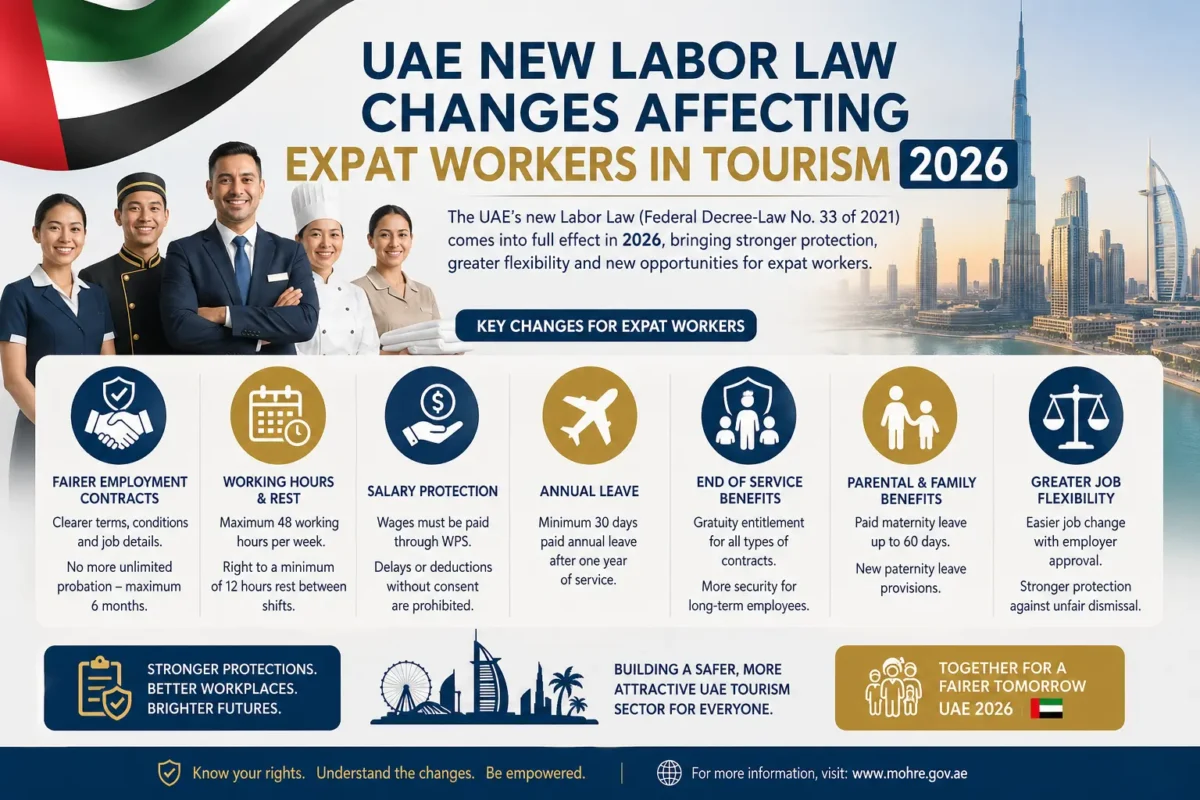
The primary legislation governing all private sector employees in the UAE — including the entire tourism and hospitality industry — is Federal Decree-Law No. 33 of 2021. This landmark law replaced the previous 1980 legislation and came into full effect in early 2022. It has since been amended and strengthened through 2024 and 2025, with its provisions in full active force throughout 2026.
The law applies to all employers and employees in the UAE’s private sector, covering both UAE nationals and expatriates alike. It does not apply to government employees, domestic workers — who are governed separately — or those working under the independent frameworks of the Dubai International Financial Centre or Abu Dhabi Global Market free zones.
Understanding this law is not optional for expat tourism workers. It is the document that defines your rights, your employer’s obligations, and what happens if either party fails to live up to those commitments.
The End of Unlimited Contracts — What Expats Must Know
Fixed-Term Contracts Are Now Mandatory for Everyone
One of the most consequential structural changes for expat workers in tourism is the complete abolition of unlimited employment contracts. Under the current framework, all private sector employment in the UAE — including every hotel, resort, travel agency, and tour operator — must now use fixed-term contracts as the standard model.
These contracts are typically structured for two to three years and are fully renewable by mutual agreement. For expat tourism workers, this change brings two significant advantages. First, it creates absolute clarity about the terms of employment from day one — your salary, job responsibilities, benefits, and termination conditions must all be clearly stated in writing. Second, it establishes a defined renewal point at which you can legitimately renegotiate your terms or move to a new employer without facing the old restrictions that previously made job mobility in the UAE complicated.
Job Mobility Without a No-Objection Certificate
In a change that has transformed the expat employment experience, the requirement to obtain a No-Objection Certificate from your current employer before moving to a new job has been effectively dismantled. Expat workers in tourism can now change employers with significantly less friction, subject to serving appropriate notice periods. This is enormous news for hospitality professionals who may have previously felt trapped in underperforming workplaces because switching jobs seemed legally or financially risky.
Wage Protection — Stricter Enforcement in 2026
The Wage Protection System Is Getting Teeth
The UAE’s Wage Protection System — commonly called WPS — requires all private sector employers to pay salaries through approved banks or exchange houses within 15 days of the end of each pay period. This system has existed for years, but enforcement in 2026 is considerably tougher.
The Ministry of Human Resources and Emiratisation, known as MOHRE, is now using digital payroll monitoring and real-time reporting tools to track compliance. Employers who delay salary payments, pay less than the contracted amount, or route payments outside the official system face fines that in 2026 range from AED 100,000 to AED 1 million per violation — with penalties multiplied by the number of workers affected, up to a maximum of AED 10 million.
For expat tourism workers, this means your salary protections are stronger and more enforceable than at any previous point in UAE history. If your employer is withholding pay, MOHRE has both the authority and the digital tools to act quickly.
End-of-Service Gratuity — Expats’ Most Valuable Financial Benefit
How Gratuity Is Calculated in 2026
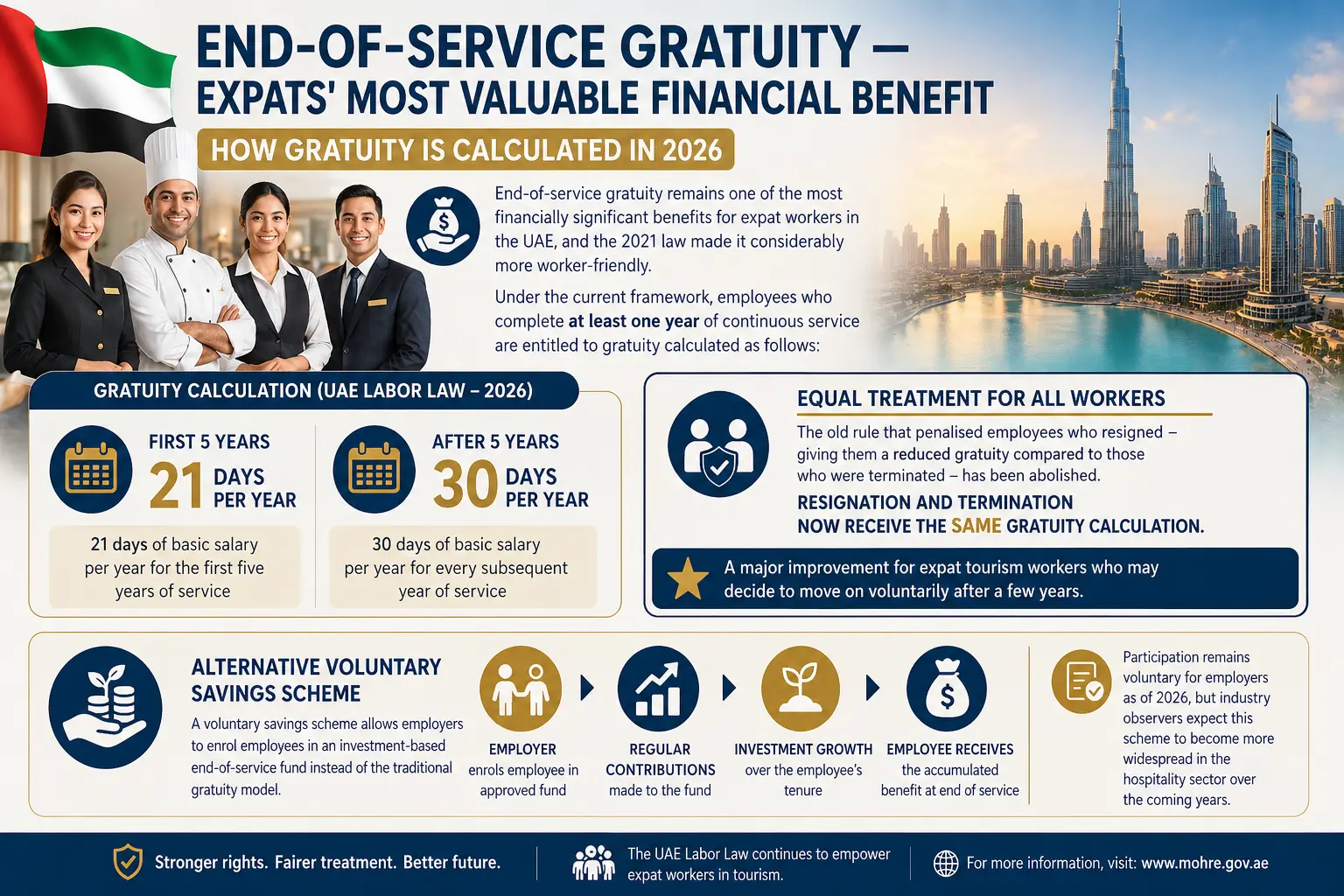
End-of-service gratuity remains one of the most financially significant benefits for expat workers in the UAE, and the 2021 law made it considerably more worker-friendly. Under the current framework, employees who complete at least one year of continuous service are entitled to gratuity calculated at 21 days of basic salary per year for the first five years of service, rising to 30 days per year for every subsequent year.
Critically, the old rule that penalised employees who resigned — giving them a reduced gratuity compared to those who were terminated — has been abolished. Resignation and termination now receive the same gratuity calculation, which is a major improvement for expat tourism workers who may decide to move on voluntarily after a few years.
An alternative voluntary savings scheme was also introduced, allowing employers to enrol employees in an investment-based end-of-service fund instead of the traditional gratuity model. Participation remains voluntary for employers as of 2026, but industry observers expect this scheme to become more widespread in the hospitality sector over the coming years.
Strengthened Anti-Discrimination Protections
Your Rights Against Unfair Treatment
The 2026 labor framework explicitly prohibits employers from discriminating against workers based on gender, race, colour, religion, national origin, social origin, or disability. For expat tourism workers — who come from an extraordinarily diverse range of nationalities — this is an important legal backstop.
Employers are also prohibited from withholding personal documents including passports, a practice that was historically a serious concern for some lower-wage hospitality workers. Any employer found holding an employee’s passport faces legal consequences, and workers in this situation have clear recourse through MOHRE.
Dispute Resolution — Faster, Fairer, and More Accessible
How to Raise a Labor Complaint in 2026
If something goes wrong in your employment — unpaid wages, unfair dismissal, contract violations — the 2024 amendments to the labor law significantly strengthened and accelerated the dispute resolution process. MOHRE now holds binding decision-making authority for employment disputes valued at AED 50,000 or less, meaning many common disputes can be resolved without going to court at all.
When a complaint is filed, MOHRE can order your employer to continue paying your salary for up to two months while the investigation proceeds — preventing the financial pressure that previously forced many expat workers to drop legitimate grievances simply to survive. If a dispute is not resolved within 14 days of MOHRE involvement, the case is automatically referred to the UAE courts.
The limitation period for filing labor claims has also been extended from one year to two years from the date the issue arose. This gives expat tourism workers a meaningful window to pursue claims even after their employment has ended.
Working Hours, Leave, and Worker Wellbeing
What the Law Guarantees Tourism Sector Employees
The standard working day under UAE labor law remains eight hours, with a maximum of 48 hours per week. Overtime is permitted but capped at two additional hours per day, and employees must receive either time off in lieu or financial compensation at a premium rate for any overtime worked.
Annual leave entitlement stands at 30 calendar days per year after completing 12 months of service — a genuinely generous allowance compared to many other international hospitality markets. Employees are also entitled to up to 90 days of sick leave per year, with the first 15 days at full pay, the next 30 at half pay, and the final 45 unpaid. Maternity leave for female employees is 60 days, with the first 45 at full pay.
During Ramadan, working hours are reduced by two hours per day for all employees — a provision that applies across the tourism and hospitality sector regardless of religion.
The Bigger Picture for Expat Tourism Professionals
The UAE’s labor law evolution in 2026 tells a clear story: this is a country that wants to attract and retain the best global talent to power an industry it has decided is central to its economic future. The reforms are not simply bureaucratic adjustments — they represent a genuine shift toward a more transparent, equitable, and professionally secure environment for the expat workforce that keeps Dubai’s world-famous hospitality machine running.
If you are an expat worker in UAE tourism, knowing your rights under this framework is not just useful — it is essential. Understand your contract, track your salary payments, keep copies of all your employment documents, and never hesitate to use MOHRE’s digital services if something does not feel right.
The UAE is one of the most rewarding places in the world to build a hospitality career. In 2026, it is also becoming one of the most protected.