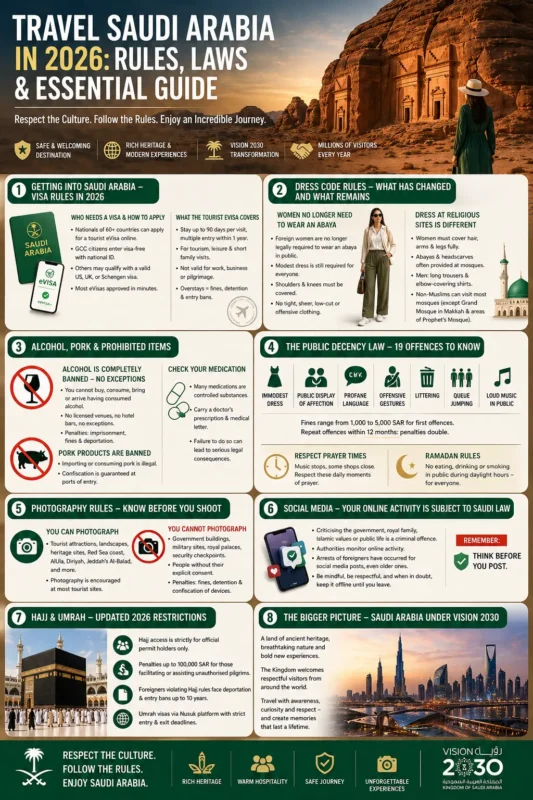
Saudi Arabia is one of the most extraordinary travel transformations of the modern era. A country that only opened its doors to international leisure tourists in 2019 has, in less than a decade, evolved into a destination drawing tens of millions of visitors with its ancient Nabataean ruins, dramatic Red Sea coastline, vast golden deserts, and a cultural energy that is unlike anything else on earth.
But Saudi Arabia is also a country where the rules matter — deeply. Travelling here without understanding its laws and cultural expectations is a genuine risk that can turn a dream trip into a very stressful experience. The good news is that the rules are clear, the Kingdom is genuinely welcoming to respectful visitors, and 2026 brings important updates every traveller needs to know.
This is your complete guide.
Getting Into Saudi Arabia — Visa Rules in 2026
Who Needs a Visa and How to Apply
Saudi Arabia’s tourist eVisa programme, one of the cornerstones of its Vision 2030 tourism push, has expanded its reach significantly. Nationals from more than 60 countries are now eligible to apply for a tourist eVisa online, and the application process is fully digital — most approvals come through within minutes. Citizens of GCC countries enter visa-free using their national identity cards.
Travellers from countries not on the direct eVisa eligibility list may still qualify if they hold a valid and previously used visa from the United States, United Kingdom, or any Schengen country. This is a particularly useful route for many Asian, African, and Latin American passport holders who would otherwise need to apply through a Saudi consulate.
What the Tourist eVisa Covers
The standard Saudi tourist visa allows a stay of up to 90 days per visit within a one-year multiple-entry validity. It covers tourism, leisure travel, and short family visits but explicitly does not cover work, business activities, or pilgrimage purposes, which each require their own specific visa categories. Overstaying your visa in 2026 carries stricter consequences than in previous years — digital immigration tracking has been significantly tightened, and penalties including fines, detention, and future entry bans are actively enforced.
Dress Code Rules — What Has Changed and What Remains
Women No Longer Need to Wear an Abaya
This is one of the most significant and widely welcomed changes in recent Saudi tourism history. Foreign women visiting Saudi Arabia are no longer legally required to wear an abaya — the traditional full-length black robe — in public spaces. This rule was officially relaxed as part of Vision 2030’s social reforms, and it applies throughout the country, including in Riyadh, Jeddah, and AlUla.
However, modest dress is still legally required for everyone. Both men and women must keep shoulders and knees covered in public areas. Tight-fitting clothing, sheer fabrics, low-cut necklines, and clothing bearing offensive imagery or profane language are all prohibited under Saudi Arabia’s Public Decency Law and can result in fines.
Dress at Religious Sites Is Different
When visiting mosques and religious sites, the rules are considerably stricter. Women must cover their hair, arms, and legs fully, and most mosques that welcome tourists provide abayas and headscarves on-site. Men must wear long trousers and shirts that cover the elbows. Non-Muslims are welcome to visit most mosques in Saudi Arabia with the exception of the Grand Mosque in Mecca and the immediate vicinity of the Prophet’s Mosque in Madinah, which remain restricted exclusively to Muslims.
Alcohol, Pork, and Prohibited Items
Alcohol Is Completely Banned — No Exceptions
This is non-negotiable. Alcohol is entirely prohibited in Saudi Arabia for everyone, including tourists. You cannot buy it, consume it, bring it into the country, or arrive having consumed it. There are no licensed venues, no hotel bars, and no exceptions for non-Muslim visitors. The penalties for alcohol-related violations are severe and can include imprisonment and deportation.
Pork products are similarly banned from import and consumption. Customs officials actively check bags for these items at all ports of entry, and confiscation is the guaranteed outcome if any is found.
Many medications that are routine in other countries are classified as controlled substances in Saudi Arabia. Before travelling, check that every medication in your luggage is legally permitted and carry a certified doctor’s prescription and medical letter for any prescription drugs. Failing to do this can result in serious legal complications at customs.
The Public Decency Law — 19 Offences to Know
What Is and Isn’t Acceptable in Public
Saudi Arabia’s Public Decency Law formally identifies 19 specific offences, enforced by regular police. These include immodest dress, public displays of affection between any two people, using profane language or offensive gestures, littering, queue-jumping, and playing loud music in public spaces. Fines start at 1,000 Saudi Riyals and can reach 5,000 Riyals for first offences, with penalties doubling for repeat violations within a twelve-month period.
During prayer times throughout the day, music in public spaces is turned off and some shops temporarily close. This is part of daily life in Saudi Arabia and tourists are expected to respect these moments quietly. During Ramadan, eating, drinking, and smoking in public during daylight hours is prohibited for everyone regardless of faith.
Photography Rules — Know Before You Shoot
Where You Can and Cannot Point Your Camera
Photography at Saudi Arabia’s breathtaking tourist sites — AlUla, Hegra, Diriyah, the Red Sea coast, and Jeddah’s historic Al-Balad — is fully permitted and actively encouraged by the tourism authorities. However, strict rules apply everywhere else.
Photographing government buildings, military installations, royal palaces, and security checkpoints is illegal and can result in immediate detention and confiscation of your devices. Just as importantly, photographing people — especially women — without their explicit consent is a punishable offence under both the Public Decency Law and Saudi cybercrime regulations. The fine for unauthorised photography of a person is 1,000 Riyals for a first offence, but sharing such photographs online can escalate the case significantly under cybercrime laws that carry far heavier penalties.
Social Media — A Rule That Catches Tourists Off Guard
Your Online Activity Is Subject to Saudi Law
Perhaps the most important and least-understood rule for modern travellers is this: what you post on social media about Saudi Arabia — including posts made before you arrive or after you leave — can have legal consequences while you are on Saudi soil. Criticising the Saudi government, the royal family, Islamic values, or Saudi public life online is a criminal offence. Saudi authorities have arrested foreign nationals for social media posts, including historical posts made years before their visit.
Be mindful, be respectful, and when in doubt about whether something is appropriate to share publicly — save it for after you have departed the country.
Hajj and Umrah — Updated 2026 Restrictions
Important Rules for Pilgrims and Religious Visitors
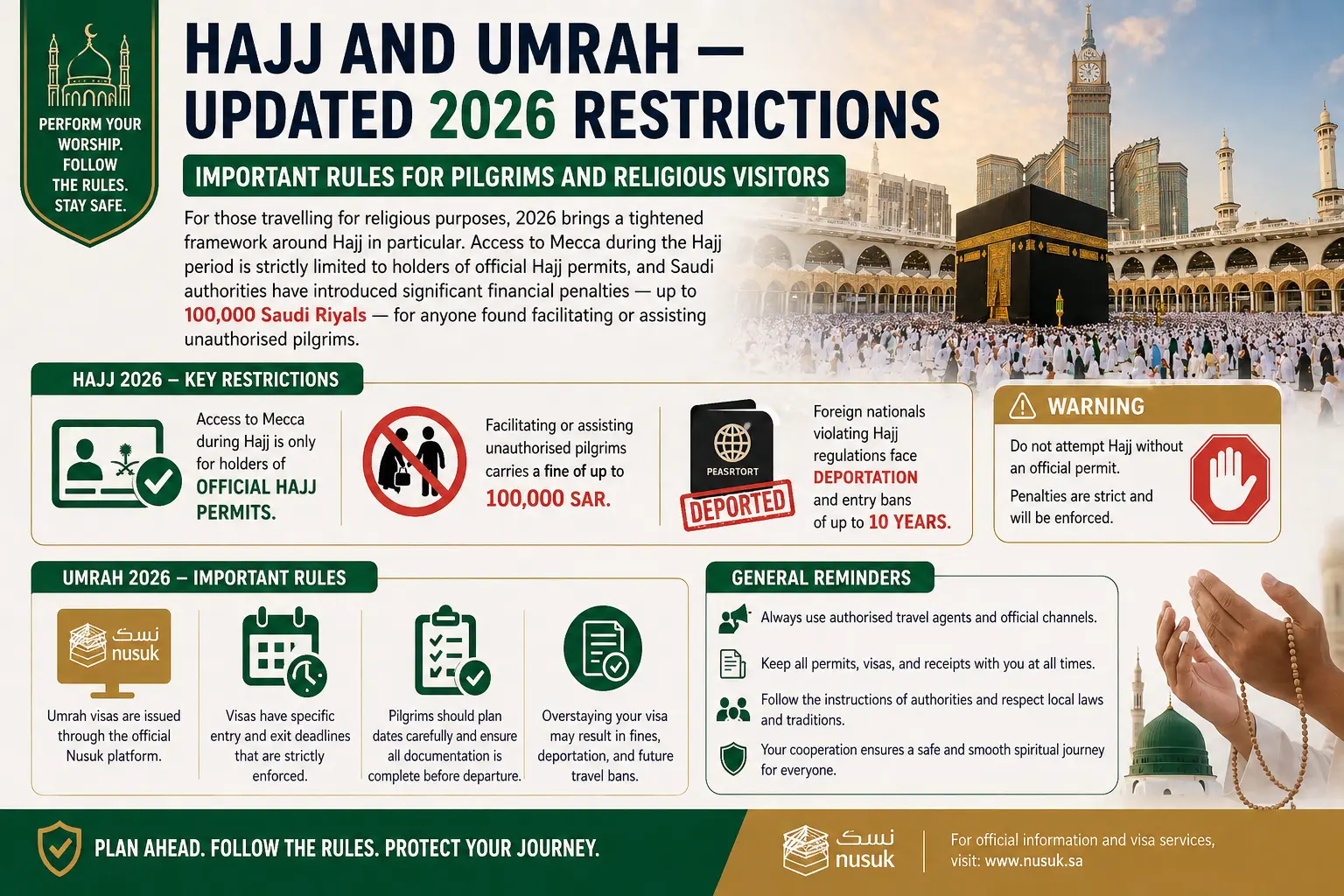
For those travelling for religious purposes, 2026 brings a tightened framework around Hajj in particular. Access to Mecca during the Hajj period is strictly limited to holders of official Hajj permits, and Saudi authorities have introduced significant financial penalties — up to 100,000 Saudi Riyals — for anyone found facilitating or assisting unauthorised pilgrims. Foreign nationals violating Hajj regulations face deportation and entry bans of up to ten years.
Umrah visas are issued through the official Nusuk platform and carry specific entry and exit deadlines that are strictly enforced. Pilgrims should plan dates carefully and ensure all documentation is complete before departure.
The Bigger Picture — Saudi Arabia Under Vision 2030
Saudi Arabia in 2026 is a country in the middle of a remarkable transformation. Entertainment venues, mixed-gender events, international concerts, luxury desert resorts, and world-class museums are all part of a tourism landscape that barely existed a decade ago. The Kingdom genuinely wants visitors — it is actively investing billions in making tourism easier, more accessible, and more rewarding.
The rules outlined here are not designed to intimidate. They are the framework within which an extraordinary culture operates — a culture that is ancient, proud, generous, and genuinely fascinating. Travel Saudi Arabia with awareness, curiosity, and respect, and you will find a country that far exceeds every expectation you brought with you.