
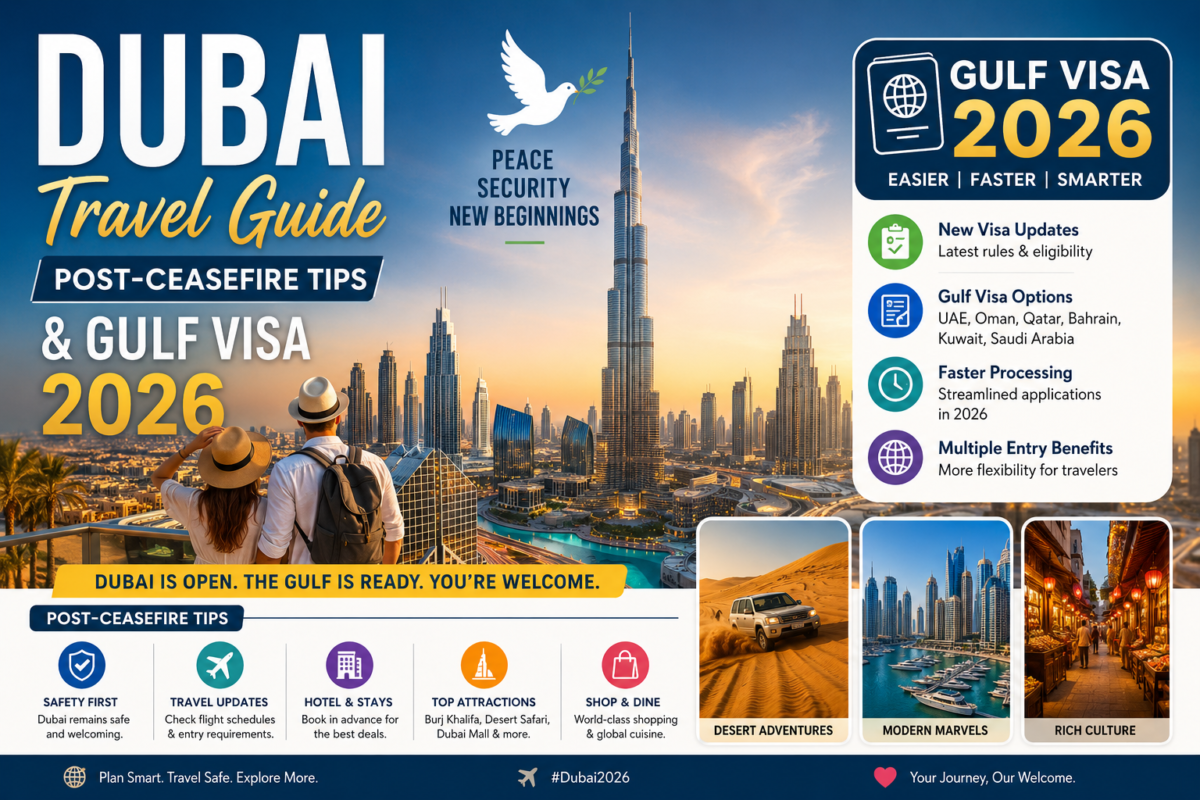
Dubai is back — and it is coming back stronger than most people expected. After months of regional tension that rattled flight schedules, emptied hotel lobbies, and kept nervous travellers at home, the post-ceasefire recovery in the UAE is well underway. If you have been sitting on the fence about visiting Dubai in May 2026, this guide breaks down everything you need to know — from the current state of travel safety to the much-talked-about Gulf Schengen Visa and the best deals available right now.
Dubai After the Ceasefire: A City Bouncing Back Fast
The Tourism Hit Was Real — But So Is the Recovery
The regional crisis earlier this year hit Dubai’s tourism industry harder than most destinations could absorb. Hotel occupancy plummeted from a healthy 86% in January to under 23% city-wide by mid-March, with booking cancellations spiking dramatically within just 48 hours of tensions escalating. For a city built entirely around hospitality, global connectivity, and visitor spending, those numbers were genuinely alarming.
But Dubai did not wait around for things to fix themselves. The government moved quickly, rolling out a multi-billion-dirham economic support package that covered fee relief for all hospitality establishments — hotels, hotel apartments, and holiday homes alike. Price controls on essential goods were introduced to prevent inflation from squeezing visitors during the fragile recovery window. The message sent to the tourism industry was clear: stay open, stay staffed, and stay competitive.
What This Recovery Means for You as a Traveller
For anyone planning a visit, the practical upshot is a destination that is actively fighting for your booking. Hotels are fully operational, staff levels are maintained, and booking flexibility has improved significantly across the board. Many properties are now offering free cancellation windows that simply did not exist before the crisis. This is not a city limping along — it is one gearing up fast for a strong second half of 2026.
Is It Safe to Fly to Dubai in May 2026?
Flight Networks Are Rebuilding Steadily
This is the first question every traveller asks, and the answer is a cautious but genuine yes. The major Gulf carriers have been steadily rebuilding their networks since early March, and the ceasefire has significantly accelerated that process.
Emirates is currently operating around 125 of its usual 140-plus destinations and is actively working to restore its full network as regional airspace conditions continue to stabilise. Etihad Airways has resumed flights to approximately 80 destinations from Abu Dhabi and is offering free rebooking on previously cancelled flights through mid-June 2026 — a rare level of flexibility that gives travellers real peace of mind. Budget carrier flydubai has pushed back above 100 active routes and has even been launching brand new services throughout the recovery period, which signals genuine confidence in near-term demand.
Travel Advisories: What Governments Are Actually Saying
Most Western governments currently advise exercising a high degree of caution for UAE travel rather than issuing outright “do not travel” warnings. That distinction is critical. A caution advisory means assess your situation and travel thoughtfully — it is not a blanket prohibition. Check your specific government’s latest advisory before booking, understand what your travel insurance covers, and choose refundable fares wherever your budget allows.
European aviation authorities maintained some operational restrictions on Gulf routes through mid-May. However, the strong expectation is that a sustained period of stability will lead to those being lifted, after which European carriers are expected to restore Gulf services at a rapid pace. If you are flying from Europe, keep a close eye on route availability over the coming weeks.
The Gulf Grand Tours Visa: Your Complete Explainer
What Is the GCC Grand Tours Visa?
You have almost certainly seen headlines calling it the “Gulf Schengen Visa.” The official name is the GCC Grand Tours Visa, and it is one of the most significant developments in Gulf tourism in decades. The concept mirrors Europe’s Schengen system directly — instead of applying for separate visas for every country you want to visit across the Arabian Peninsula, one single permit covers the entire Gulf Cooperation Council region.
The six countries included are the UAE, Saudi Arabia, Qatar, Bahrain, Kuwait, and Oman. A traveller who previously had to submit three separate visa applications, three sets of documents, and three separate fees just to visit Dubai, Riyadh, and Muscat will soon be able to do the entire trip on one permit. For multi-country Gulf itineraries, the cost savings alone are substantial — travellers currently spend upwards of USD 400 per person on separate visa applications for a six-stop Gulf tour.
How Long Is It Valid and What Does It Cost?
The GCC Grand Tours Visa is expected to be valid for 30 to 90 days depending on the type selected, covering both tourism and short-term business travel. Estimated fees are in the range of USD 110 to 130 for multi-country itineraries. Applications will be submitted through a unified online digital platform, making the process far simpler than the current fragmented system of six different national portals.
When Does It Actually Launch?
Here is where travellers need to be realistic. The visa is not fully live yet. A confirmed live pilot is scheduled for the fourth quarter of 2026, beginning with a Dubai–Bahrain air corridor. The delay comes down to the enormous technical complexity of linking six separate national immigration systems in real time — each country currently runs its own digital platforms, biometric databases, and security watchlists. Building shared infrastructure that allows all six borders to honour a single permit requires deep systems integration that authorities are understandably taking seriously rather than rushing.
What Should You Do for Your Trip Right Now?
If you are travelling to Dubai this May or June, the unified visa does not yet affect your booking. You apply through the standard UAE tourist visa process, which has itself been significantly upgraded recently. Dubai launched an AI-powered platform called Salama that allows visa renewals, cancellations, and queries to be handled within minutes rather than days. EU passport holders currently enjoy 90 days visa-free entry to the UAE, and many other nationalities can access streamlined e-visa options processed within a few business days.
If you are planning a broader multi-country Gulf itinerary for late 2026, keep your travel dates flexible, avoid non-refundable bookings tied to visa availability, and watch for official announcements from GCC tourism boards in the third quarter of the year.

Best Dubai Deals to Book in May 2026
Hotels Are Offering Rare Value Right Now
This is genuinely one of the best windows to visit Dubai in years, and travellers who understand the market are taking full advantage. The post-crisis dip in demand means hotels across every category are competing hard for bookings. Government fee deferrals running through June 2026 allow properties to hold rates competitive while maintaining full staffing and service levels.
Expect four-star quality at three-star prices. Complimentary room upgrades, flexible check-in policies, free breakfast inclusions, and dining package deals are all more common right now than they have ever been in Dubai’s recent history. Luxury properties that were fully booked and charging premium rates just three months ago now have availability and genuine incentive to impress.
Flight Deals Worth Acting On Now
For flights, promotional fares are circulating across multiple carriers as airlines actively push to rebuild passenger volumes on recently restored routes. Emirates, Etihad, and flydubai are all competing for the same recovering market, and that competition produces direct benefits for the traveller in the form of lower base fares, complimentary upgrades, and flexible rebooking terms.
Set price alerts on multiple flight booking platforms simultaneously. Lock in fares early because as stability holds and confidence builds, demand will return quickly and prices will rise to match. The current pricing environment is a direct product of temporary disruption — it will not last.
The Shoulder Season Advantage
May also marks the beginning of Dubai’s shoulder season, where rising temperatures bring falling prices across the board. Visitors who can handle warm weather — and Dubai’s air-conditioned everything makes it manageable — are rewarded with significantly lower hotel rates, less crowded attractions, and a more relaxed overall pace across the city.
Final Word
Dubai in May 2026 represents an unusually well-timed travel opportunity. The city is fully operational, actively incentivised to impress visitors, and priced more generously than it has been in years. The Gulf Grand Tours Visa is the landmark story shaping the region’s travel future, and while it will not be in your passport for this trip, its late-2026 pilot will redefine how the world explores the Gulf. For now, book flexible, travel smart, and take advantage of a recovery window that will not stay open forever.