Saudi Arabia has opened its doors to international tourism in a way that would have seemed unimaginable just a decade ago. Vision 2030, the kingdom’s ambitious national transformation program, has unlocked a country that was previously almost entirely closed to leisure travelers — and what tourists are discovering when they arrive is a destination that defies almost every stereotype built up over years of distance and misunderstanding.
The ancient Nabataean tombs of AlUla rival Petra in sheer breathtaking scale. The Red Sea coastline is among the most pristine and biologically rich in the world. Riyadh’s dining and arts scene has exploded with creativity. The Empty Quarter — the largest continuous sand desert on the planet — stretches across the southern horizon in a silence so complete it rearranges something inside you.
But Saudi Arabia is also a country with a deeply rooted cultural identity, a strong sense of social values, and expectations of visitors that differ significantly from what most Western or even regional tourists are accustomed to. Getting the cultural etiquette right is not just about avoiding trouble — it is about genuinely connecting with a country and a people who, when met with respect and curiosity, are among the most generous and welcoming hosts you will ever encounter anywhere in the world.
This guide covers everything a first-time visitor to Saudi Arabia needs to know about cultural etiquette — what to do, what absolutely not to do, and the nuanced middle ground that separates a respectful visitor from an oblivious one.
Understanding the Foundation: Why Etiquette Matters So Much Here
Before getting into the specific rules, it helps to understand the cultural framework that gives rise to them. Saudi Arabian society is shaped by two powerful, intertwined forces: Islamic faith and tribal tradition. Both place enormous emphasis on hospitality, family honor, community respect, and the preservation of social harmony.
For Saudi people, cultural etiquette is not a set of arbitrary rules — it is a living expression of values that have defined community life for centuries. When a visitor respects those values, even imperfectly, it signals something important: that you see Saudi Arabia as a place with genuine depth worth engaging with, not just a backdrop for photographs. That signal matters enormously to local people, and it changes the quality of every interaction you have in the country.
Saudi Arabia has modernized rapidly and continues to do so. Many of the restrictions that existed even five years ago have been significantly relaxed. But core cultural values around modesty, respect for religion, hospitality protocols, and social conduct remain deeply important, and being aware of them will make your experience immeasurably richer.
Dress Code: The Most Visible Form of Respect
For Women
Saudi Arabia no longer legally requires foreign women to wear an abaya — the full-length black robe — in public. This changed as part of the tourism reforms, and the shift is genuine. However, modest dress is still strongly expected and culturally important throughout the country.
What modest dress means in practice: clothing that covers your shoulders, chest, arms, and legs to at least the knee. Loose, flowing fabrics work best both culturally and practically given the climate. Maxi dresses, wide-leg trousers, long tunics, and lightweight long-sleeved tops are all ideal choices. Avoid anything tight, sheer, low-cut, or form-fitting when out in public spaces.
In more conservative areas — particularly in cities like Abha, Buraydah, or smaller rural towns — dressing more conservatively than the minimum is wise and will be appreciated. In cosmopolitan Riyadh neighborhoods like Diriyah or in AlUla during its arts festivals, the atmosphere is noticeably more relaxed, but modest dress remains the respectful default everywhere.
A headscarf is not required for non-Muslim women in public spaces. It is, however, required when entering any mosque — and if you plan to visit historic mosques as part of your cultural exploration, carrying a light scarf in your bag at all times is practical and respectful.
For Men
Men are expected to dress modestly as well. Long trousers are appropriate everywhere. Shorts are acceptable in some tourist-oriented areas and resorts but are generally frowned upon in traditional markets, religious sites, and conservative neighborhoods. Sleeveless shirts and very casual beachwear should be reserved for private resort settings only.
Greetings: The Art of the Saudi Welcome
Greetings in Saudi Arabia carry genuine weight and meaning. Rushing past them or treating them as a quick formality is considered rude and cold.
The standard Islamic greeting — “As-salamu alaykum” (peace be upon you) — is the universal opener for almost any interaction. Responding correctly with “Wa alaykum as-salam” (and upon you peace) demonstrates basic respect and almost always generates an immediate warmth from the person you are greeting. Even attempting this in your imperfect Arabic is received with appreciation rather than correction.
Among men, handshakes are common and sometimes accompanied by a gentle touch to the heart afterward, signaling sincerity. Some very traditional Saudi men will greet close friends by touching noses — the traditional Gulf greeting — but this is not something tourists need to initiate or expect.
Physical contact between unrelated men and women in public is not appropriate. This is perhaps the most important social etiquette point for mixed-gender groups of travelers to internalize. A Western male tourist extending a handshake to a Saudi woman he has just met is likely to cause awkwardness — Saudi women who observe the traditional values of their faith do not shake hands with unrelated men. Wait for the other person to initiate any physical greeting, and if none is initiated, a warm smile and verbal greeting are perfectly sufficient and entirely respectful.
The Sacred Rules Around Prayer Times
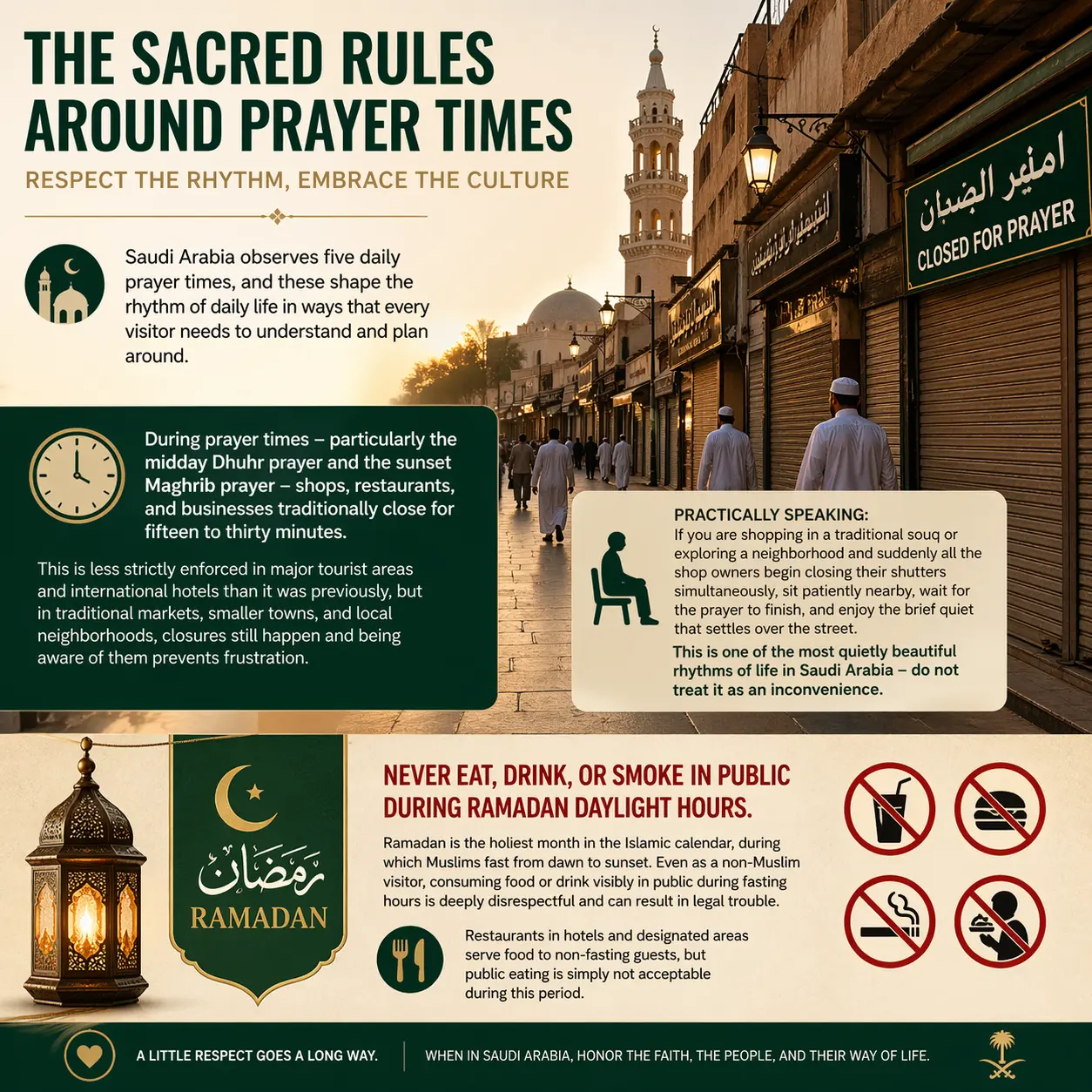
Saudi Arabia observes five daily prayer times, and these shape the rhythm of daily life in ways that every visitor needs to understand and plan around.
During prayer times — particularly the midday Dhuhr prayer and the sunset Maghrib prayer — shops, restaurants, and businesses traditionally close for fifteen to thirty minutes. This is less strictly enforced in major tourist areas and international hotels than it was previously, but in traditional markets, smaller towns, and local neighborhoods, closures still happen and being aware of them prevents frustration.
Practically speaking: if you are shopping in a traditional souq or exploring a neighborhood and suddenly all the shop owners begin closing their shutters simultaneously, sit patiently nearby, wait for the prayer to finish, and enjoy the brief quiet that settles over the street. This is one of the most quietly beautiful rhythms of life in Saudi Arabia — do not treat it as an inconvenience.
Never eat, drink, or smoke in public during Ramadan daylight hours. Ramadan is the holiest month in the Islamic calendar, during which Muslims fast from dawn to sunset. Even as a non-Muslim visitor, consuming food or drink visibly in public during fasting hours is deeply disrespectful and can result in legal trouble. Restaurants in hotels and designated areas serve food to non-fasting guests, but public eating is simply not acceptable during this period.
Photography Etiquette: What You Can and Cannot Capture
Saudi Arabia contains some of the most photogenic landscapes, architecture, and cultural scenes in the world. It is also a country where photography requires more thoughtfulness than many tourists initially expect.
Always ask permission before photographing people. This is a universal courtesy in any country, but in Saudi Arabia it carries particular importance. Photographing Saudi women — especially in traditional dress — without explicit permission is deeply inappropriate and considered a serious invasion of privacy. Many Saudi women will decline to be photographed entirely, and that preference deserves complete respect without question or argument.
Never photograph government buildings, military installations, palaces, or security infrastructure. This is a legal boundary, not just a social one. The consequences of ignoring it can be severe, including detention and confiscation of equipment. If you are uncertain whether a building has official status, err on the side of not photographing it.
Mosques require specific permission to photograph. Some mosques welcome non-Muslim visitors and permit respectful photography; others do not allow non-Muslims inside at all. Research specific mosques before visiting, dress appropriately, and always ask before pointing a camera at anything inside a religious space.
Heritage sites like AlUla, Hegra, and Diriyah are enthusiastically photograph-friendly — these are places the Saudi government actively wants the world to see and share.
Dining Etiquette: Food as an Expression of Hospitality
Saudi hospitality is legendary, and it expresses itself most powerfully through food. Being invited to share a meal in a Saudi home or at a traditional gathering is one of the greatest honors a visitor can experience, and knowing how to conduct yourself at the table matters.
Accept offers of coffee and dates. When you are welcomed into any formal or informal Saudi setting, you will almost certainly be offered Arabic coffee — qahwa — a lightly spiced, cardamom-flavored brew served in small handleless cups, accompanied by dates. Accepting this offering is the correct and respectful response. Declining without good reason can be perceived as rejecting the hospitality itself, which is socially awkward at best and mildly offensive at worst. If you have had enough coffee, gently tilt your cup from side to side when handing it back — this signals that you are satisfied without having to say anything.
Eat with your right hand. In Islamic tradition, the left hand is considered impure, and eating or passing food with the left hand is disrespectful at a traditional Saudi table. For right-handed travelers this is natural; left-handed visitors should make a conscious effort, particularly when sharing communal dishes.
Communal dining is common. Many traditional Saudi meals are served on large platters placed in the center of a shared space, with everyone eating from the same dishes. This is not a sign of informality — it is a sign of genuine welcome and community. Participate enthusiastically and do not treat communal food as unhygienic.
Alcohol does not exist in Saudi Arabia. The kingdom maintains a complete prohibition on alcohol — there are no licensed bars, no hotel minibars with wine, and no exceptions for tourists. Do not attempt to bring alcohol into the country through customs, as penalties are serious. Saudi Arabia has an extraordinary culture of non-alcoholic social drinking — fresh fruit juices, layered mocktails, traditional herb teas, and elaborate coffee preparations are the social beverages of choice and are genuinely excellent.
Public Behavior: The Unwritten Social Code
Public displays of affection between couples are not appropriate. Holding hands between spouses is generally tolerated in cosmopolitan areas, but kissing, embracing, or any more intimate contact in public is not acceptable and can attract the attention of authorities.
Loud, disruptive behavior in public spaces is considered deeply disrespectful. Saudi public culture values dignity, calm, and restraint. Shouting, aggressive bargaining, public arguments, or drawing excessive attention to yourself runs counter to the social values of a culture that prizes composure.
Queueing and patience. Saudi culture has a different relationship with queueing than many Western travelers are accustomed to. Rather than becoming frustrated, adapt your pace and approach interactions with patience and good humor.
Do not criticize Islam, the royal family, or Saudi governance in public or on social media while you are in the country. Freedom of expression as understood in Western democracies does not apply in the same way under Saudi law, and public criticism of the religion or government can have serious legal consequences.
In Mosques and Religious Sites
Non-Muslims are not permitted to enter the two holiest mosques in Islam — the Grand Mosque in Mecca and the Prophet’s Mosque in Medina. These cities are entirely closed to non-Muslim visitors. This is not negotiable and should be understood and respected completely before planning your itinerary.
Other mosques across Saudi Arabia vary in their policies toward non-Muslim visitors. Some historic mosques welcome respectful visitors outside of prayer times; always confirm in advance and follow all instructions given by staff or caretakers without question.
Remove your shoes before entering any mosque. Maintain silence or speak only in very hushed tones. Turn your phone to silent. Do not walk in front of people who are praying. These are basic courtesies that apply universally across the Islamic world and represent the absolute minimum of respectful behavior in a religious space.
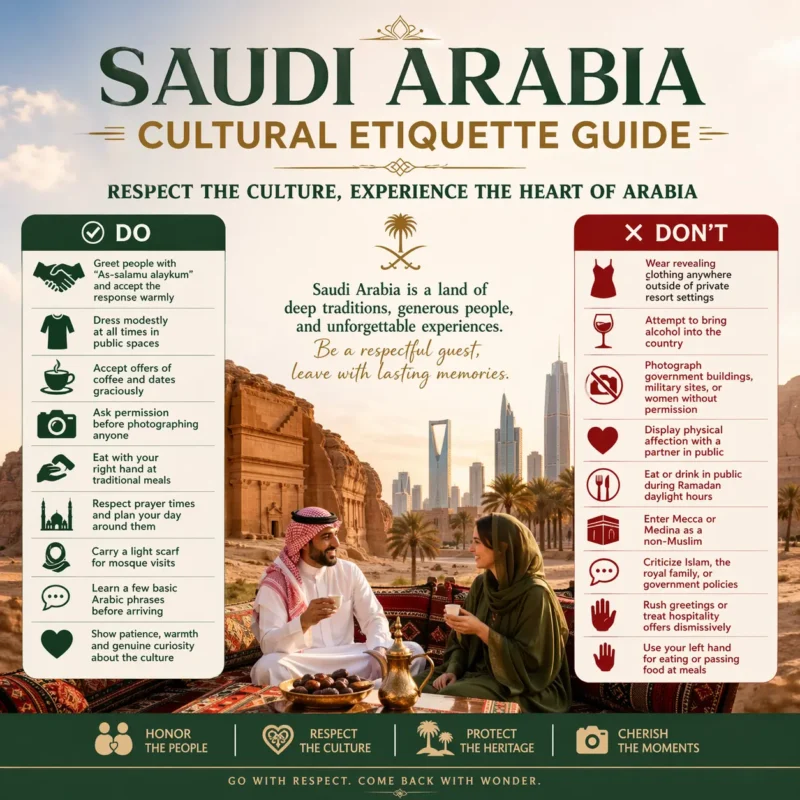
Do’s and Don’ts: Quick Reference Guide
DO:
- Greet people with “As-salamu alaykum” and accept the response warmly
- Dress modestly at all times in public spaces
- Accept offers of coffee and dates graciously
- Ask permission before photographing anyone
- Eat with your right hand at traditional meals
- Respect prayer times and plan your day around them
- Carry a light scarf for mosque visits
- Learn a few basic Arabic phrases before arriving
- Show patience, warmth, and genuine curiosity about the culture
DON’T:
- Wear revealing clothing anywhere outside of private resort settings
- Attempt to bring alcohol into the country under any circumstances
- Photograph government buildings, military sites, or women without permission
- Display physical affection with a partner in public
- Eat or drink in public during Ramadan daylight hours
- Enter Mecca or Medina as a non-Muslim
- Criticize Islam, the royal family, or government policies publicly or online
- Rush greetings or treat hospitality offers dismissively
- Use your left hand for eating or passing food at traditional meals
A Final Word: Curiosity Is the Best Etiquette
Every rule in this guide matters, but the single most important thing you can bring to Saudi Arabia as a first-time visitor is genuine curiosity. Saudi people are extraordinarily well-educated, widely traveled, deeply proud of their heritage, and entirely aware of how their country is perceived by the outside world. What they respond to most powerfully is not a visitor who has memorized a list of rules but one who arrives with authentic interest in understanding the country on its own terms.
Ask questions — respectfully. Accept invitations — graciously. Admit what you do not know — honestly. Make mistakes and learn from them with good humor. Saudi hospitality is not fragile; it can absorb the occasional cultural misstep from someone who is clearly trying. What it responds to best, though, is the traveler who treats Saudi Arabia not as an exotic backdrop but as a living, breathing civilization with four thousand years of history and a people who are extraordinarily proud of who they are and genuinely excited to share it.
Go with respect. Come back with wonder. Saudi Arabia will earn both.
First impressions last — make yours count in the Kingdom.