Oman is one of those rare countries that makes you feel like a genuine explorer rather than a tourist. While its more famous neighbours in the Gulf have built their identities around manufactured luxury and record-breaking architecture, Oman has quietly held onto something far more valuable — authenticity. Ancient forts that have stood for centuries, wadis so turquoise they look digitally enhanced, mountain villages where life moves at the same unhurried pace it has for generations, and a coastline so vast and unspoiled that you can walk for an hour without seeing another person.
Most travelers who visit Oman stick to the well-worn path: Muscat, Nizwa, the Wahiba Sands, and Wadi Shab. These are wonderful places and absolutely worth seeing — but they represent only the thinnest surface layer of what this country has to offer. Beneath that surface lies an Oman that fewer visitors ever reach, and the beautiful irony for budget travelers is that the hidden, off-the-beaten-path Oman is almost always cheaper, less crowded, and more rewarding than the popular version.
This guide takes you to the places that deserve far more attention than they get — Oman’s genuine hidden gems, chosen specifically for travelers who want maximum experience with minimum spending.
Why Oman Works So Well for Budget Travelers
Before diving into the destinations, it helps to understand why Oman is genuinely one of the best value countries in the entire Middle East for independent budget travel.
Oman has an extraordinary network of free natural attractions. The wadis, mountains, canyons, beaches, and desert landscapes that make this country visually spectacular cost nothing to visit — no entrance fees, no guided tour requirements, no tourist infrastructure markup. You simply drive there, park, and experience them.
Food in local Omani restaurants and roadside spots is inexpensive and outstanding. A plate of shuwa-spiced rice, grilled fish, or a bowl of harees at a local eatery rarely costs more than OMR 1 to OMR 2 — roughly USD 2.50 to USD 5. The country’s guesthouses and rest houses outside Muscat are affordable and often include home-cooked meals. Renting a car — which is practically essential for reaching hidden gems — is relatively affordable, and Oman’s roads are among the best-maintained in the region, making self-driving genuinely accessible even for first-time visitors.
With a modest daily budget, you can experience Oman at a depth that most package tourists, ironically spending far more money, never reach.
1. Wadi Damm — The Wadi Nobody Talks About
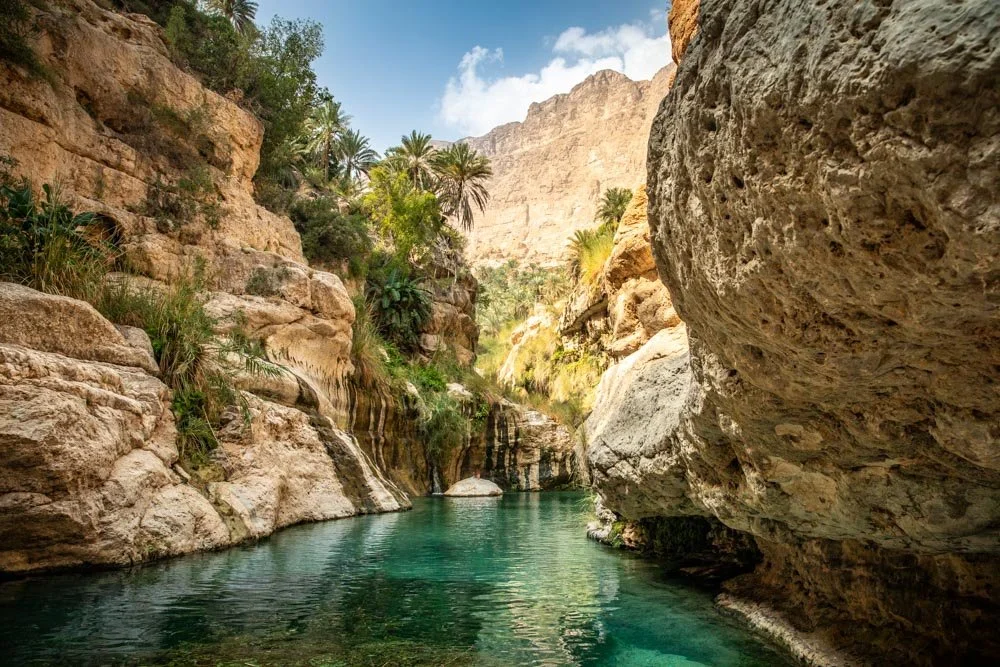
Everyone knows Wadi Shab. Far fewer people know about Wadi Damm, and that is precisely what makes it special. Located in the Al Sharqiyah region of northern Oman, Wadi Damm is a long, dramatic canyon carved through rust-colored rock with a series of natural pools, palm groves, and narrow gorge sections that require nothing more strenuous than a simple walk to reach.
The water in Wadi Damm runs cool and clear even in warmer months, the rock formations are spectacular, and on any given weekday you may find yourself entirely alone here — a genuinely rare experience in an age where Instagram has made every beautiful place a crowded one. There are no entry fees, no boat rides to book, no queues. Just raw, beautiful Omani nature at its most accessible.
Budget tip: Pack your own food and water from the nearest town before heading in. There are no facilities at the wadi itself, which is part of its unspoiled charm.
2. Al Hamra — An Ancient Mud-Brick Town Frozen in Time
Most visitors to the Hajar Mountains region stop at Nizwa and consider the job done. Those who drive just forty minutes further west discover Al Hamra, and most of them immediately wish they had allocated more time.
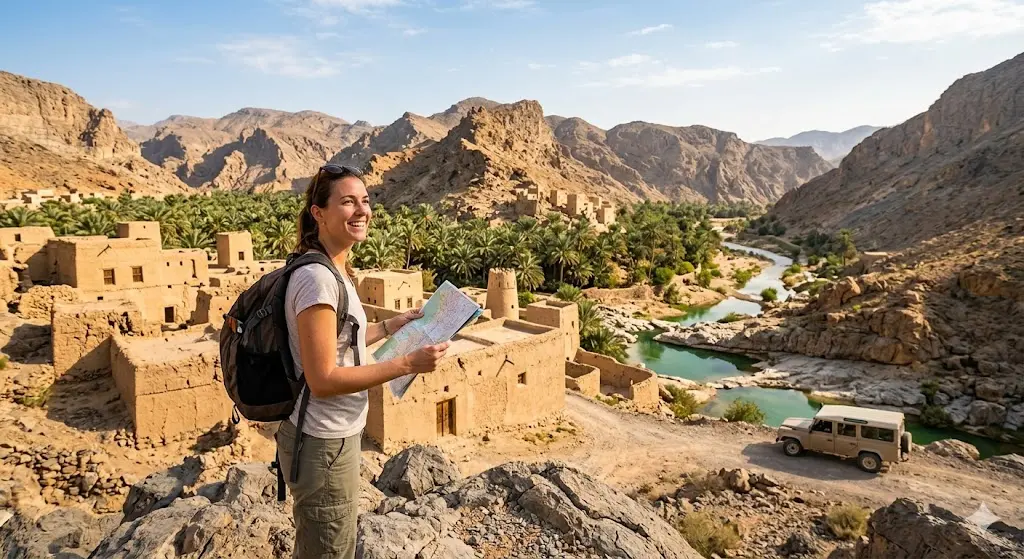
Al Hamra is one of the oldest and best-preserved mud-brick settlements in Oman. Its multi-storey earthen houses, some dating back four hundred years, rise from the base of the dramatic Hajar Mountains in shades of ochre and amber that glow magnificently in the afternoon light. Many of the structures are abandoned but structurally intact, creating an extraordinary open-air time capsule that you can wander through largely undisturbed.
The town sits at the entrance to Wadi Ghul — sometimes called the Grand Canyon of Arabia — a massive geological fissure that drops over a thousand meters into the earth and stretches for kilometers through the mountains. The viewpoint above the wadi costs nothing to reach and delivers views that are genuinely among the most dramatic in the entire Arabian Peninsula.
From Al Hamra you can also access the Misfat Al Abriyeen village, a short drive up the mountain. This tiny ancient settlement is built into a cliff face surrounded by terraced date palm gardens and traditional falaj irrigation channels that have been channeling mountain water to crops for over a thousand years. It is jaw-droppingly beautiful and almost entirely free to explore.
Budget tip: There is a small but excellent traditional guesthouse in Misfat Al Abriyeen that offers simple rooms and home-cooked Omani meals at very reasonable rates. Staying here overnight rather than driving back to Nizwa saves fuel money and gives you the extraordinary experience of waking up inside a living ancient village.
3. Fins Beach — Oman’s Most Beautiful Secret Coastline
Oman has over three thousand kilometers of coastline, and the vast majority of it is completely undeveloped. Fins Beach, located between Muscat and Sur on the eastern coast, is widely considered by those who know it to be the most beautiful beach in the country — which means it is also one of the most beautiful beaches in the entire Middle East.
The beach is a sweeping arc of fine white sand backed by dramatic limestone cliffs and hills of fossilized coral. The water is a shade of deep turquoise that changes color through the day as the sun moves across the sky. Snorkeling here is outstanding — the reef just offshore hosts an abundance of marine life, and you need nothing more than a basic snorkel mask, available in any Muscat dive shop for a few rials, to experience it.
There are no hotels here, no beach clubs, no sunbed rental operations, and no entrance fees. You bring what you need, you leave only footprints, and you have access to a beach that would be world-famous and prohibitively expensive in almost any other country on earth.
Budget tip: Camp overnight. Wild camping on Omani beaches is legal and widely practiced, and waking up to sunrise over the Sea of Oman from your tent on Fins Beach is the kind of experience that money genuinely cannot buy elsewhere.
4. Wadi Bani Khalid in the Quiet Season
Wadi Bani Khalid is technically not unknown — it appears in most Oman travel guides. But here is the hidden gem version of it: visit outside the peak October to March tourist season, specifically in late April or early May before temperatures peak, and you will find a landscape that looks completely different from the busy weekend crowds that pack it during winter.
The natural pools are deeper and greener after winter rains. The surrounding date palms are thick and lush. The small villages along the wadi road are unhurried and genuinely welcoming of independent travelers who stop to buy fresh dates or a cold drink. Small local restaurants near the wadi entrance serve grilled chicken, rice, and fresh salads for under OMR 2 per person.
The wadi itself is free to enter. The swimming is exceptional. And in the quiet season, the atmosphere is meditative rather than festive — a completely different, and arguably better, experience.
5. Tiwi Village and the Forgotten Coastal Road
The coastal road between Muscat and Sur is one of Oman’s most scenic drives, but most travelers take the inland highway to save time. This is a genuine mistake for anyone who values beauty over efficiency.
The coastal route passes through Tiwi, a small fishing village nestled between the mountains and the sea where brightly painted traditional dhow boats sit on the beach and the local community goes about daily life with total indifference to tourist attention. There are no souvenir shops here, no guided tours, and no entry fees. Just an authentic Omani fishing village that looks and feels exactly as it has for decades.
From Tiwi, a short rough track leads down to Wadi Tiwi — a long green valley cutting deep into the Hajar Mountains, lined with date palms, terraced gardens, and small villages connected by narrow mountain paths. Unlike the more famous wadis, Wadi Tiwi receives a fraction of the visitors and offers a far more intimate, unhurried experience.
Budget tip: The coastal road between Muscat and Sur takes about three hours longer than the highway. Pack a picnic from the Muscat morning market, fill your water bottles, and treat the drive itself as part of the experience.
6. Jebel Akhdar’s Lesser-Known Villages
Jebel Akhdar — the Green Mountain — is increasingly popular, and the resort at its peak has brought more tourist attention to this part of the Hajar range than it has ever seen before. But the mountain is enormous, and the famous resort represents only a tiny fraction of what it contains.
The villages of Ash Shirayjah, Al Ayn, and Wadi Bani Habib on the terraced slopes of Jebel Akhdar are largely invisible to the tourist circuit. These ancient agricultural communities grow pomegranates, roses, and apricots on terraced hillsides maintained by generations of the same families. The rose harvest season in spring fills the mountain air with a fragrance unlike anything you will encounter anywhere else in the Gulf.
Walking between villages on the old mountain paths costs nothing. The views across the canyon systems below are staggering. Locals are accustomed to occasional independent travelers passing through and are genuinely welcoming — a warm cup of qahwa coffee offered without any expectation of payment is a common experience on these mountain trails.
7. Sur’s Dhow Yard — Living Maritime History for Free
The coastal town of Sur at the southeastern tip of Oman’s main peninsula is the last place in the country where traditional wooden dhows are still built by hand using techniques passed down through families for centuries. The dhow building yard at Sur is one of the most extraordinary living heritage sites in the entire Arab world — and visiting it is completely free.
You can walk through the yard, watch craftsmen shaping planks of teak by hand, smell the wood shavings and the salt air, and have conversations with workers who are genuinely proud of their craft and happy to explain what they are building and why. The nearby Sur Maritime Museum charges a token entry fee and provides context for what you are seeing at the yard.
Sur itself is an underrated budget base for exploring the southeastern coast. Accommodation is cheaper here than in Muscat, local seafood restaurants are outstanding value, and the nearby Ras al Jinz Turtle Reserve — where green turtles nest year-round — is one of the most genuinely moving wildlife experiences in Oman.
Practical Budget Travel Tips for Exploring Oman’s Hidden Gems
Rent a car and share costs. Almost all of Oman’s hidden gems require private transport. Renting a small 4×4 and splitting the cost between two or three travelers makes the per-person daily expense very manageable and gives you the freedom to stop wherever you want.
Shop at local souqs and bakeries. Fresh Omani bread, dates, dried fruits, local honey, and prepared snacks from market stalls and roadside bakeries are inexpensive, delicious, and far better fuel for a day of exploration than overpriced tourist cafe food.
Learn a few words of Arabic. Oman is one of the most hospitable countries on earth, and any effort to engage in Arabic — even badly — is received with extraordinary warmth. Conversations opened by a simple greeting can lead to invitations for coffee, tips for unmarked viewpoints, and connections that no guidebook could ever provide.
Travel light and carry cash. Outside Muscat and major towns, ATMs are rare and card machines nonexistent. Carry sufficient Omani rials in small denominations before heading into rural areas.
Respect the environment. Oman’s natural treasures are hidden gems precisely because they have been kept clean, unmodified, and free of commercial development. Pack out everything you bring in, do not disturb wildlife, and leave every place exactly as you found it — for the next traveler and for the country that has trusted visitors to behave well here.
Final Thought
Oman’s greatest gift to the budget traveler is that its most extraordinary experiences are mostly free. The wadis do not charge admission. The mountains do not require a guide. The beaches have no sunbed fees. The ancient villages ask only that you walk respectfully through their lanes.
What Oman asks in return is time, curiosity, and a willingness to drive past the signposted tourist stop to see what is around the next bend. Almost always, what is around that next bend is worth every minute of the detour.
This is the Oman that budget travelers lucky enough to find it carry with them for the rest of their lives.
Drive slowly, look closely, and let Oman surprise you — it will, every single time.