If you have been thinking about visiting Dubai, Doha, Riyadh, Muscat, or Bahrain in 2026, the question on every traveler’s mind right now is simple: is it actually safe to go? The honest answer is not a straightforward yes or no. The Gulf region in April 2026 is a place of striking contrasts — world-class luxury, booming tourism infrastructure, and genuine resilience sitting alongside a geopolitical situation that demands real attention before you book. This guide breaks down every angle so you can make a truly informed decision.
What Triggered the Current Situation?
The Gulf’s travel disruption in 2026 did not happen overnight. On February 28, 2026, an active armed conflict involving Iran, the United States, and Israel escalated sharply, sending shockwaves through the entire region. Iran launched missile and drone strikes targeting Gulf states including the UAE, Saudi Arabia, Bahrain, Kuwait, and Qatar in response to US and Israeli strikes inside Iranian territory.
Airspace across large parts of the region became intermittently restricted or temporarily closed. Short-notice closures were implemented as a precautionary measure, particularly in high-risk corridors over the Gulf, creating widespread disruption for millions of travelers who had booked trips months in advance.
The good news is that a ceasefire was agreed on April 8, 2026, creating a window for negotiations. However, the situation remains fragile and evolving day by day, which is exactly why so many travelers are actively researching before committing to any Gulf booking.
The Airspace Picture: Country by Country
This is the most critical factor for any traveler right now. Not every Gulf country is equally affected, and the airspace situation varies significantly depending on where you are flying to.
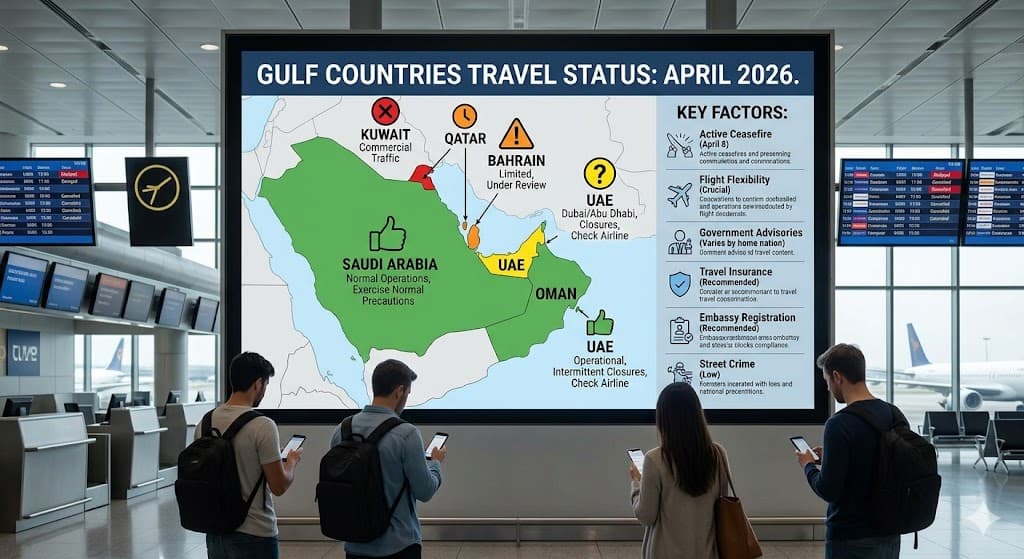
Kuwait has been the hardest hit. Kuwait International Airport sustained damage from drone strikes and remains closed to commercial flights as authorities carry out safety assessments and infrastructure repairs. Travel to Kuwait is not recommended at this time.
Bahrain is in partial recovery. Bahraini airspace has gradually begun reopening with limited flight operations resuming. However, an EU-wide safety advisory remains in force and schedules are subject to change at very short notice.
UAE (Dubai & Abu Dhabi) remains the most connected hub in the region. Emirates and flydubai have been steadily increasing departures, recording their highest single-day totals since the conflict began. That said, intermittent airspace closures continue and drone interceptions over UAE territory have been reported. Confirm your flight within 48 hours of departure.
Qatar is operational but limited. Qatar Airways continues to fly select international routes under special permissions, but Qatar’s airspace remains largely closed to other commercial carriers.
Saudi Arabia and Oman are the most open destinations currently. Both countries have maintained accessible airspace throughout much of the conflict period, making them the comparatively safer entry points for travelers committed to visiting the Gulf right now.
Major European airlines including British Airways, Lufthansa, Air France, and KLM remain grounded across most Gulf routes under the European Union Aviation Safety Agency bulletin, which has been extended through late April 2026 pending further review.
Is the Ground-Level Safety Different from the Headlines?
One of the most important distinctions for any traveler to understand is the gap between the geopolitical headlines and the on-the-ground experience inside Gulf cities. These are two very different conversations.
The Gulf states — even during this period — maintain extremely low rates of street crime. Hotels, malls, hospitals, beaches, and tourist zones remain operational. Local law enforcement and infrastructure continue to function at a high standard across all major cities.
The real risk for tourists is not street-level danger but rather the unpredictability of the security environment — meaning flight cancellations at short notice, sudden airspace closures, and the very real possibility of being stranded mid-trip in a city where your return flight has just been suspended. Travelers visiting the Gulf right now should treat flexibility as a non-negotiable part of their planning, not an optional add-on.
Which Gulf Destinations Are Safest Right Now?
If you are set on visiting the Gulf in the near term, here is a realistic breakdown by destination:
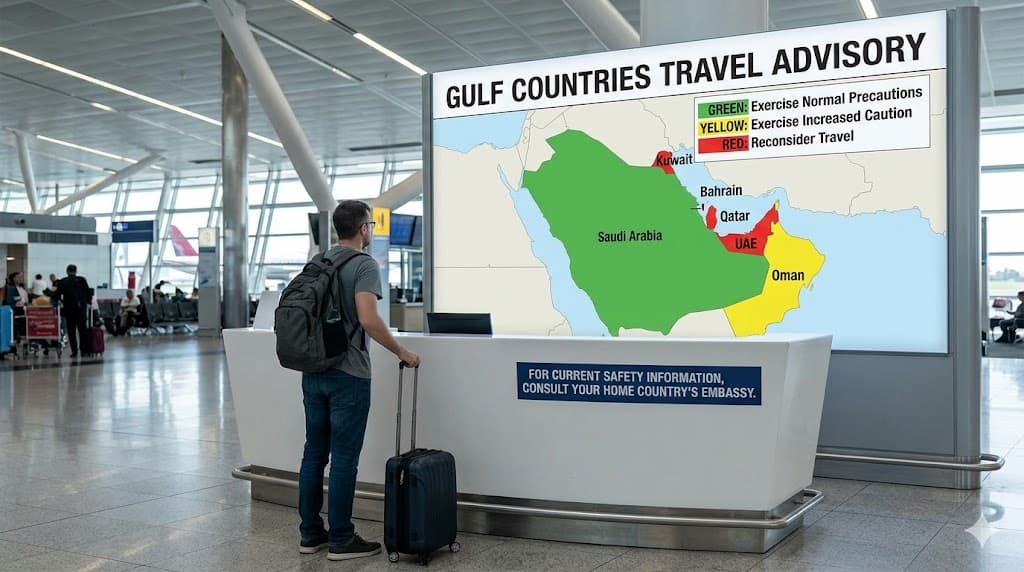
Oman stands out as the most travel-friendly destination at this moment. The Sultanate saw visitor numbers actually increase in early 2026 despite regional tensions, a remarkable signal of its relative stability. Its airspace is open, its infrastructure is intact, and Oman’s geographic position on the southeastern edge of the Arabian Peninsula keeps it somewhat removed from the main conflict corridors. For anyone wanting a Gulf experience right now, Oman is the strongest choice.
Saudi Arabia is also receiving travelers with relative normality. Riyadh and Jeddah remain operational aviation gateways. The country’s Vision 2030 tourism ambitions have given its government enormous motivation to keep the sector running, and it shows. Visitors to Saudi Arabia in April 2026 are still enjoying Red Sea resorts, heritage sites, and city experiences without major on-the-ground disruption.
UAE (Dubai/Abu Dhabi) remains viable for arrivals, particularly if flying on Gulf-based carriers. Dubai recorded nearly 20 million international overnight visitors in 2025 — one of the highest totals in its history — and the city is doing everything possible to maintain that momentum. Confirm your specific flights carefully before departure.
Qatar, Bahrain, and Kuwait carry higher current risk and should be approached with particular caution. Full airspace recovery in these countries has not yet been confirmed as of mid-April 2026.
What Governments Are Telling Travelers
Multiple governments have updated their travel advisories for the Gulf region. The UK, Canada, Australia, India, and the United States have all issued guidance urging travelers to exercise heightened caution, verify flights before heading to the airport, and have clear contingency plans in place.
On April 7, 2026, GCC tourism ministers held an extraordinary joint meeting and issued a collective statement affirming that Gulf nations remain open and safe for visitors. This reflects the genuine commitment of Gulf governments to keeping their tourism economies alive and sending positive signals to the world.
However, travelers must weigh official Gulf government statements against the independent advisory guidance issued by their own home governments. Both perspectives matter. The GCC’s message is one of resilience and continued welcome — and it is sincere. The independent advisories are a reminder that on-the-ground conditions can shift quickly and personal preparedness is essential.
The Recovery Is Already Starting
Here is the bigger picture that alarming headlines often obscure: the Gulf is already actively recovering. Following the ceasefire, Saudi Arabia immediately began increasing inbound flight capacity. Dubai and Abu Dhabi reported rising passenger traffic within days of the agreement. Qatar Airways moved quickly to restore routes. Oman leveraged the reopening of travel routes to promote its natural and heritage tourism offerings.
The structural foundations of Gulf tourism remain exceptionally powerful. These countries have collectively invested hundreds of billions of dollars into tourism infrastructure over the past decade. The political will to recover quickly is not just present — it is urgent. Vision 2030 in Saudi Arabia, the UAE’s D33 Agenda, and Qatar’s post-World Cup tourism strategy all treat international visitor numbers as a core national priority.
History reinforces this optimism. Previous shocks to Gulf tourism — including the COVID-19 pandemic, the 2017 Qatar diplomatic crisis, and earlier regional tensions — were each followed by fast, decisive rebounds that frequently exceeded pre-crisis visitor levels within a single travel season.
Practical Safety Tips if You Do Travel
If you decide to travel to the Gulf right now, follow these practical steps to protect your trip and your safety:
- Book only refundable or flexible tickets so that sudden airspace closures do not leave you financially stranded with no recourse
- Purchase comprehensive travel insurance that explicitly covers conflict zones, trip cancellations, and emergency evacuation
- Register with your country’s embassy in every Gulf nation you visit — most governments offer free traveler enrollment programs for exactly these situations
- Follow local law strictly — photographing military activity, missile interceptions, or related damage is illegal in Saudi Arabia and the UAE and carries serious legal consequences including detention
- Monitor your airline’s app daily for real-time schedule updates — do not rely on booking confirmation emails alone during volatile periods
- Have a land exit plan ready — know which border crossings to Oman or Jordan are available from the UAE and Saudi Arabia in case air travel is disrupted during your stay
- Keep key numbers saved offline — your country’s embassy, your travel insurer’s emergency line, and your accommodation contacts should all be accessible without internet
The Bottom Line
The Gulf in April 2026 is not a no-go zone — but it is not business as usual either. Oman and Saudi Arabia are the most accessible and stable choices for near-term travel. The UAE is recovering steadily and remains the region’s most connected hub. Qatar and Bahrain are in active transition toward normality. Kuwait should be avoided entirely until commercial flights fully resume.
The traveler who visits the Gulf right now will likely find bustling cities, extraordinary hospitality, stunning architecture, and genuinely world-class experiences. But they must also accept that flight schedules could change at short notice and that the broader geopolitical environment requires active monitoring throughout their stay.
For travelers who have the flexibility to wait two to three months, the outlook improves considerably. The ceasefire has set the stage for normalization. Airlines are returning. Airspace is gradually reopening. The tourism recovery is already visible and gathering pace.
Stay informed, plan flexibly, buy good insurance, and when the skies fully clear — and they will — the Gulf will be ready to welcome you with everything it has always had to offer.