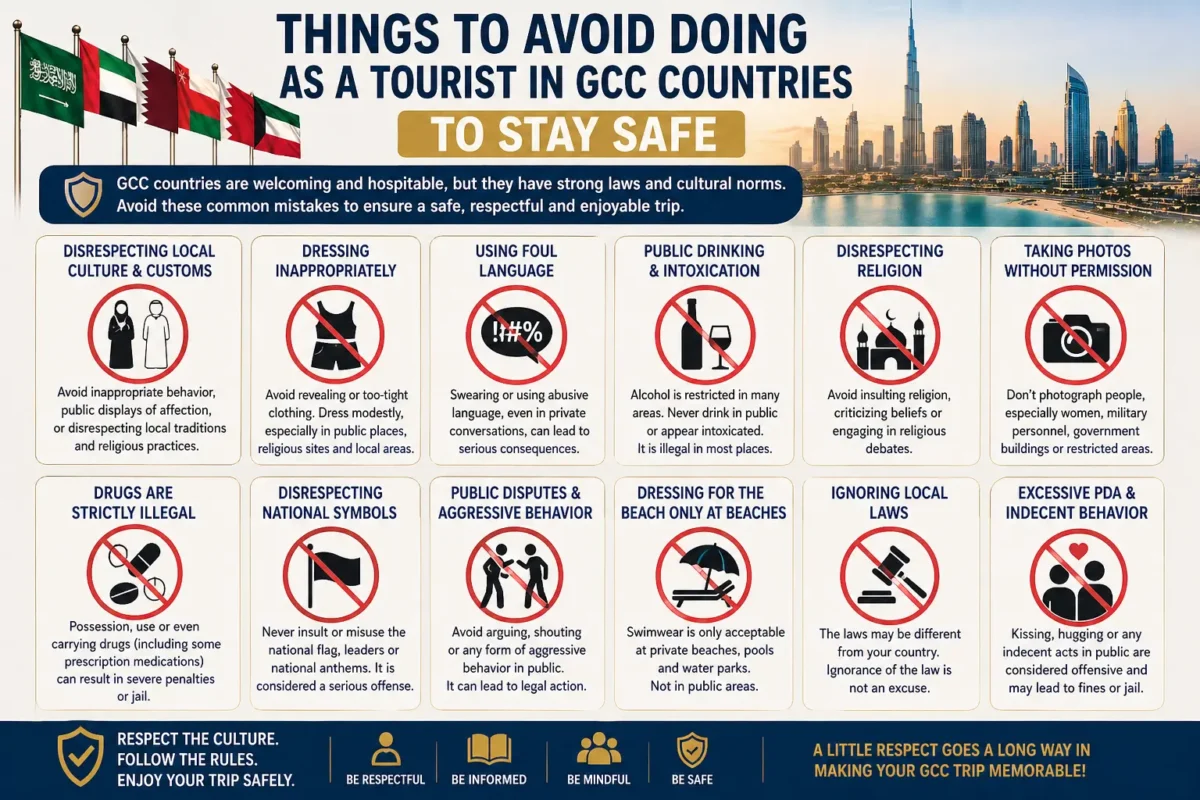
The Gulf Cooperation Council — comprising the UAE, Saudi Arabia, Qatar, Bahrain, Kuwait, and Oman — is one of the most thrilling travel regions on the planet. Gleaming skyscrapers, ancient deserts, world-class cuisine, and warmly welcoming locals make this part of the world genuinely unforgettable. But here is something every traveller must understand before they land: the Gulf operates on a set of laws, cultural values, and social expectations that are very different from most Western or even Asian countries.
What gets a laugh back home could land you in serious legal trouble here. What seems like a harmless habit could carry a fine, deportation, or even a prison sentence. This guide is not meant to scare you away from the Gulf — it’s meant to make sure you enjoy every single moment of it without an unpleasant surprise.
Here is exactly what to avoid as a tourist across GCC countries in 2026.
Never Disrespect Islamic Customs and Traditions
Ramadan Rules Apply to Everyone
One of the most important things any tourist must understand is that Islamic customs are not just cultural suggestions in GCC countries — they carry legal weight. During the holy month of Ramadan, eating, drinking, or smoking in public during daylight hours is strictly prohibited for everyone, including non-Muslim tourists. It does not matter what your personal beliefs are. Violating this rule in countries like Saudi Arabia, Kuwait, and Qatar can result in fines or detention.
Even outside of Ramadan, being mindful of prayer times is important. When the call to prayer sounds, some businesses briefly pause operations, and being loud or disruptive near mosques at any time of day is considered deeply disrespectful. A little awareness goes a very long way.
Never Enter a Mosque Without Permission or Proper Dress
Mosques across the GCC welcome curious visitors, but only on their terms. Women must cover their hair, arms, and legs before entering — most major mosques provide abayas and headscarves on-site if you don’t have your own. Men must wear long trousers and shirts that cover the elbows. Never walk into a mosque dressed casually or enter during active prayers without an invitation. Photographing worshippers inside a mosque without their permission is also deeply offensive and should always be avoided.
Dress Code Violations Can Get You Into Serious Trouble
Cover Up in Public Spaces
Across all six GCC countries, revealing clothing in public areas is either legally prohibited or socially unacceptable in ways that can attract unwanted attention and official intervention. Both men and women are expected to keep shoulders and knees covered when outside of beaches, pools, and designated resort areas.
In Saudi Arabia, modest dress in public is a legal requirement. In Qatar, public decency laws are actively enforced, especially during major events and Ramadan. Even in the more relaxed UAE, Sharjah has a particularly strict dress code, and violations across all emirates can result in fines.
The golden rule is simple: when in doubt, cover up. Pack lightweight, breathable fabrics that cover your shoulders and knees and you will never have a problem.
Public Displays of Affection Are a Legal Risk
Keep Intimacy Private
In GCC countries, kissing, hugging, and other physical affectionate gestures between couples in public spaces are considered offensive and can result in legal consequences. This applies equally to married and unmarried couples. What might seem like an innocent moment between partners in a shopping mall or on a public beach can attract complaints from other visitors or direct intervention from authorities.
Even holding hands excessively in very conservative areas can attract disapproving attention. Unmarried couples sharing hotel rooms is technically illegal in several GCC countries, though enforcement varies. Staying in separate rooms or booking as married is always the safer approach if you are not legally married.
Alcohol Laws Are Strict and Vary by Country
Know the Rules Before You Drink
Alcohol regulations vary enormously across the GCC and catching tourists off guard is surprisingly common. In Saudi Arabia, alcohol is completely banned — bringing even a gift of liqueur-filled chocolates across the border can create serious problems at customs. In Kuwait, alcohol is also entirely prohibited.
In the UAE, Qatar, and Bahrain, alcohol is available but only in licensed venues such as hotels, restaurants, and specific retail outlets. Drinking in public, being drunk in a public space, or driving under any influence of alcohol carries severe penalties including fines, imprisonment, and deportation.
Never bring alcohol into a country where it is banned, never drink outside of licensed premises, and never get behind a wheel after consuming even a single drink.
Be Very Careful With Photography
Some Places and People Are Off-Limits
Photography seems harmless until it is not. Across the GCC, photographing government buildings, military installations, palaces, and border checkpoints is strictly prohibited and can result in immediate detention and confiscation of your devices. In some cases, tourists have faced serious legal consequences for accidentally photographing restricted areas.
Just as importantly, never photograph local people — especially women — without their explicit permission. It is considered a profound invasion of privacy and is punishable under privacy laws in most GCC countries. If someone declines to be photographed, respect that immediately and completely.
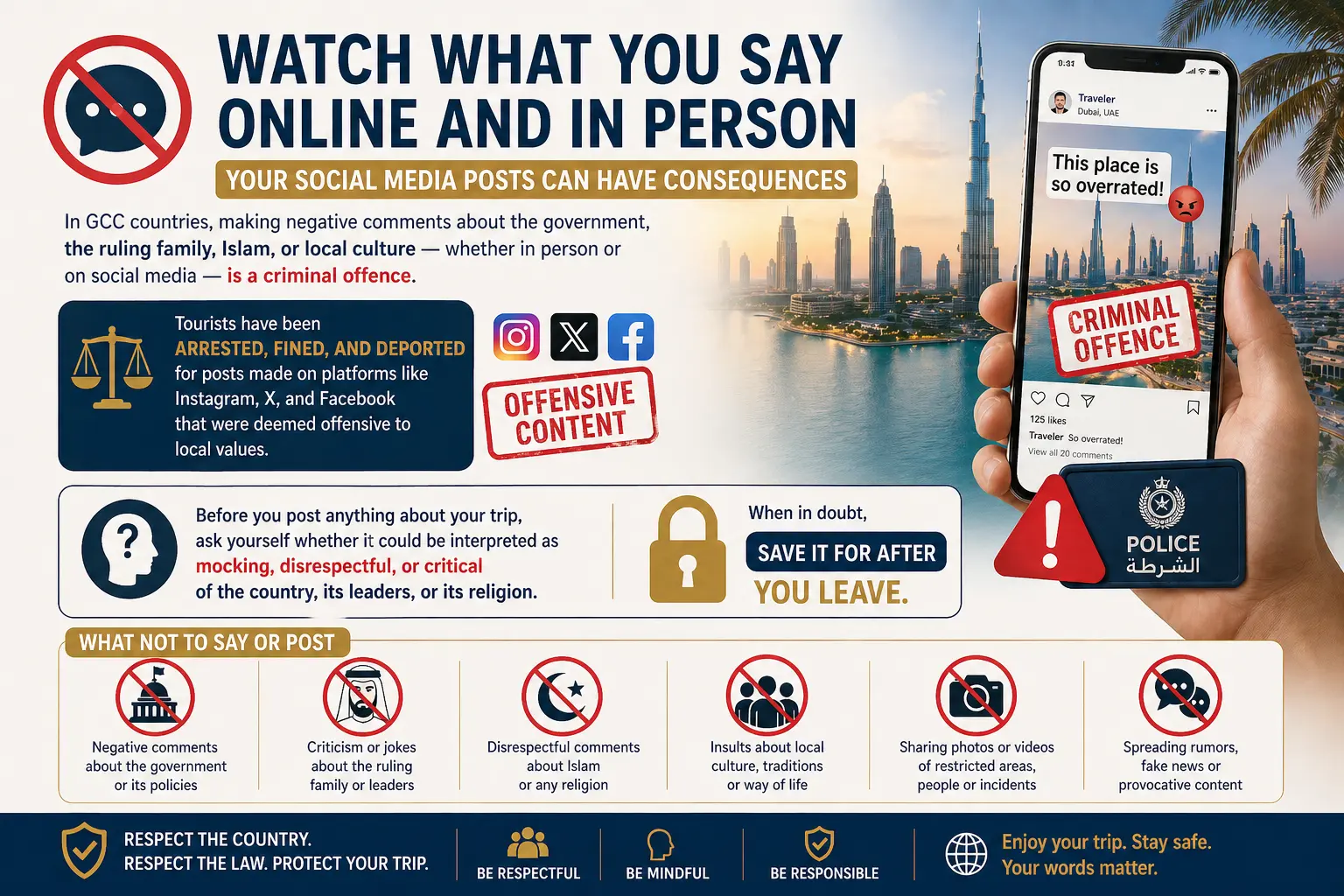
Watch What You Say Online and In Person
Your Social Media Posts Can Have Consequences
This is perhaps the most underappreciated risk for modern travellers. In GCC countries, making negative comments about the government, the ruling family, Islam, or local culture — whether in person or on social media — is a criminal offence. Tourists have been arrested, fined, and deported for posts made on platforms like Instagram, X, and Facebook that were deemed offensive to local values.
Before you post anything about your trip, ask yourself whether it could be interpreted as mocking, disrespectful, or critical of the country, its leaders, or its religion. When in doubt, save it for after you leave.
Never Carry Prohibited Medications Without Documentation
Your Prescription Drugs May Be Illegal Here
Many medications that are completely legal and widely available in Western countries are classified as controlled substances in GCC nations. Certain painkillers, antidepressants, sedatives, and even some over-the-counter cold medicines fall into this category. Carrying them across a GCC border without proper documentation — typically a doctor’s prescription, a letter from your physician, and sometimes pre-approval from the destination country’s health authority — can result in arrest.
Before any Gulf trip, check the controlled substances list for every country you plan to visit and carry certified documentation for every medication in your bag, prescribed or otherwise.
Respect the Culture and It Will Reward You
The Gulf Welcomes Respectful Visitors Warmly
The GCC is genuinely one of the safest travel regions in the world. Crime rates are low, hospitality is legendary, and locals are extraordinarily proud to share their culture with respectful visitors. The rules that exist are there to preserve a way of life that has deep meaning and centuries of history behind it.
None of the things on this list are difficult to follow — they simply require awareness and a willingness to be a thoughtful guest. Travel the Gulf with respect, humility, and genuine curiosity, and you will be rewarded with experiences that stay with you for a lifetime.
Thank you for this important guide. Many tourists underestimate cultural and legal differences in GCC countries. Your advice helps travelers avoid unintentional mistakes and respect local norms. Being aware of laws, dress codes, and public behavior ensures a safer and more enjoyable experience. This is essential reading for anyone planning a visit to the Gulf region. Highly practical and useful.
Great reminder for travelers exploring the GCC region. Respecting local laws, traditions, and social norms is essential for a safe and enjoyable trip. Dressing modestly, avoiding public misconduct, and understanding cultural sensitivities can prevent misunderstandings. The Gulf offers incredible experiences, but awareness and respect go a long way in ensuring positive interactions with locals and authorities throughout your journey. Smoothly.
Откройте для себя возможности астрологии онлайн: астрология онлайн и узнайте, как звезды влияют на вашу повседневную жизнь.
Хороший подход — занести ключевые даты в календарь и пересматривать через месяц.
надежная охрана объектов http://www.физическая-охрана-объектов.рф/ .