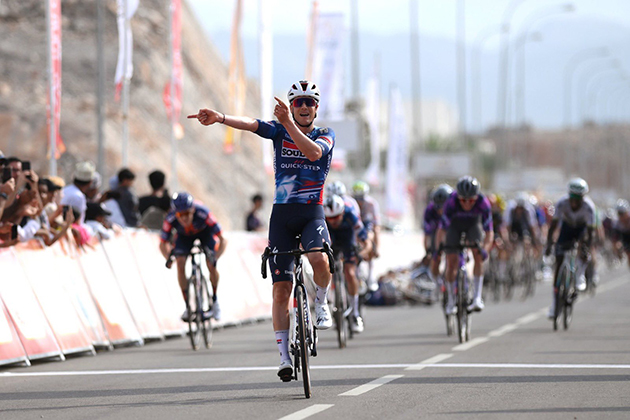
The 2025 Tour of Oman was not a cycling race but a tour of a country where history, landscape, and sports passion intersect. The coveted event will be held between 8 and 12 February 2025, and will once again have Oman in the spotlight of the world of sports, as some of the best cyclists in the world will compete against one another to truly test their stamina and spirit in the Arabian sun.
Being a part of the UCI Pro Series, the Tour of Oman is one of the most anticipated early-season races on the world bicycle calendar. It is an ideal mixture of strategy racing and breathtaking scenery – along the coastline roads that cling to the Gulf of Oman and the steep climbs through the Hajar Mountains. This year, the version pleased the audience with five exciting stages, which gave a different visual image of the diversity of Oman and the spirit of the sportspeople who won its roads.
The Road to Glory: A Race of Grit and Grandeur
The 2025 Tour of Oman was also a five-stage event taking place across the most representative locations of the Sultanate, such as the glitzy coastline of Al Rustaq and Qurayyat, to the mountainous Green Mountain (Jebel Akhdar ). The overall length of the race, surpassing 800 kilometers, was a real test of strength, in terms of which sprinters, climbers, and all-rounders were able to shine at their own moment.
It started with the opening, in the backdrop of the Corniche of Muscat, and it was a dazzling beginning. People were already there early in the morning, waving Omani flags and shouting as the peloton circumnavigated the historic center of the capital. It was a sprinter’s day, a race that was run like lightning, and the start of the future.
The second stage was more dramatic as the riders had to deal with mountainous hills and coastal winds. Race relations changed continuously, with breakaways, creating and disintegrating in a game of staying power and timing. Even before the riders got to the finish line at Sohar, the exhaustion of the early heat had already started to reflect itself – yet so had the attractiveness of the test.
Real testing of the trip was on Stage Three, the ascent of Jebel Akhdar (The Green Mountain) – the trademark climb of the Tour. This is an uphill fight, meant and well-liked by fans and dreaded by bikers. It has gradients that are above 10 percent, where legends are made, and leaders are broken. The climb stood to itself once again in 2025, as the general classification in the event shook wildly as the riders toiled to their utmost to achieve the glory.
The last two phases, negotiating through the desert plains and culminating back towards Muscat, became a showcase of tactics – a masterpiece in working as a team, positioning, and strategy. The last run along the grand Matrah Corniche, encircled by the blue gulfs of the Gulf and the rough cliffs of the Al Hajar, made it a film ending of an unforgettable race.
Oman: The Country That Makes Things Move
The world does not have many races that have the spectacular scenery as the Tour of Oman. The stages are a series of moving postcards: the dunes of the desert shining in the sunshine, palm-surrounded oases, millennium-old castles on top of cliffs, and the glittering coast that makes up the Sultanate.
To a bike rider, Oman is not only a challenge physically, but also emotionally. The land is not to be disrespected: lengthy ascents challenge the mental endurance, crosswinds compel forming alliances, and the heat is searing, down to prioritize the issue of hydration and strategy. However, all challenges are accompanied by their reward, the surreal beauty of the landscape and the hospitality of the Omani population.
The people were enthusiastic and crowded the roads, applauding international riders and rooting for the Oman National Team, which is increasingly gaining popularity in the cycling field in the region. The event has emerged as a way of uniting professional sport with community celebration, a synonym of how Oman thrives in modern sporting excellence and tradition, at the same time respecting the deep-rooted Omani traditions of hospitality and adventure.
An Event of Global Prestige
The Tour of Oman has become one of the most important one-day cycling events in Asia, and since the event was first launched in the year 2010, it has attracted very high-profile teams from Europe, the Middle East, and other regions too. Being one of the UCI ProSeries, it is only second to the highest-ranking category in the WorldTour as a competitive race, providing riders the chance to test form and gain momentum at the start of the year, to prepare them for the grand tours of the year.
The 2025 edition featured more than 18 professional teams, with a few of the WorldTour giants among them. Titles such as INEOS Grenadiers, UAE Team Emirates, and Bora-Hansgrohe contributed energy of the world standards to the event, and there were also emerging continental teams who were eager to leave their mark. To a large number of bikers, Oman is a perfect destination in their schedule of rides – a mix of challenge and discovery, with the best climate, competition, and culture.
Sport in Harmony and Sustainability
The 2025 race focused on sustainability, and this was one of its major attributes. Alongside the Ministry of Culture, Sports, and Youth of Oman, the organizers introduced several environmentally friendly activities. Reusable water stations, minimized use of plastics, and the so-called campaign of environmental consciousness, Ride Green Oman, the Tour was a good example of Oman becoming increasingly devoted to sustainable tourism and responsible management of events.
People were also advised to take part in clean-up drives and community cycling programs that were organized during the main race, making the week a festival that praised fitness, environment, and national pride.
Beyond the Finish Line: Future on the Horizon
As the last phase was over and the champion was hoisting the red jersey, despite the evening light of Muscat, it was not only his victory but also the victory of Oman. The Tour again proved the capability of the country to organize the international event of global standards and combine sport with narration.
The 2025 Tour of Oman was an endurance and excellence test for the riders. It was a motion and nature celebration for the fans. And as to Oman, it was a pronouncement that this country, with its open roads and open hearts, should be one of the great goals of international sport. As the peloton rolled away and the desert winds settled, the legacy of the Tour lingered — a memory carved into the mountains, a whisper carried across the waves, and a promise that the roads of Oman will always lead to greatness.